
What makes Kylie Jenner’s voice so recognisable?
A $50 million bra will get people talking. Fair enough.
Kylie Jenner’s Victoria’s Secret runway debut on 18 October delivered the diamonds, the wings and a very enthusiastic front row. Then she shared the rehearsals and nerves in her own backstage vlog.
For anyone interested in accents, that gives us something else to pay attention to: the voice behind the look. You might struggle to describe it, but you probably have a fairly good idea of what Kylie sounds like before pressing play.
Kylie takes viewers through preparing for the show, from rehearsals to the runway. Video: Kylie Jenner / YouTube.
So what makes a voice feel that familiar? With Kylie, two useful things to understand are vocal fry, the low, creaky texture associated with the Kardashian voice, and uptalk, where pitch rises towards the end of a statement. Add someone’s rhythm and phrasing, and there’s much more to recognise than how they pronounce a particular word.
The creak has a name
Vocal fry is that low, slightly crackly sound you sometimes hear in speech. Think of the difference between a smooth note and one with a little creak running through it.
Speech-language specialists at UW Medicine describe it as a normal voice register. People can use it deliberately, or slip into it naturally. People of different genders use it, too.
It has become so associated with the Kardashians that their name is practically shorthand for it. But vocal fry alone won’t turn a voice into Kylie’s. You could give two people the same words and ask both to use a creaky voice. You’d still hear two different people.
That matters if you’re an actor trying to build a character voice. Picking the most obvious feature is a starting point. If it’s the only thing you carry into every sentence, the impression can become a bit relentless.
Why a statement can sound like a question
Uptalk describes a rise in pitch at the end of a statement. You’re telling someone something, but the melody travels upwards.
Try saying “We’re meeting at seven” with your pitch falling at the end. Then say the same words with it rising. The information stays the same, while the way you seem to offer it changes.
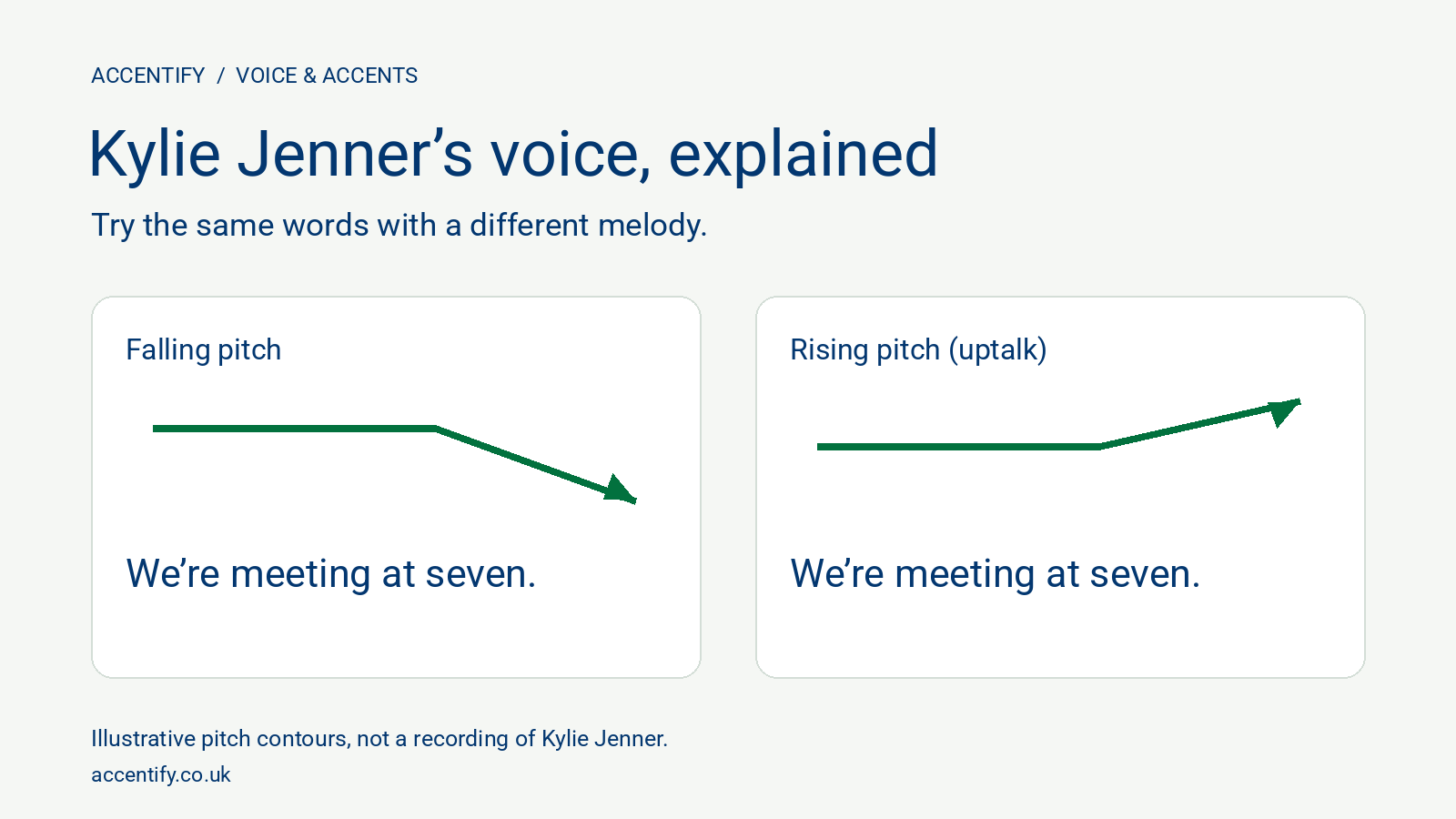
The same sentence with falling and rising pitch. Illustration: Accentify. These contours show the idea, rather than a measurement of Kylie’s speech.
A student research project published on UCLA’s Languaged Life examined Kylie’s social-media speech and identified both uptalk and vocal fry. The authors also considered how intonation helps public figures present themselves across different platforms.
That’s a useful lens for listening, rather than a rule that every Kylie sentence must rise. Someone telling a funny story, explaining a product and admitting they’re nervous has different things to communicate. A convincing voice needs room for that.
Is the “Kardashian accent” actually an accent?
The label bundles several things together. There’s pronunciation, but there’s also pitch, voice texture and the way a person puts a thought together.
Calling all of it “the accent” is understandable in everyday conversation. When you want to work out what you’re hearing, separating those ingredients helps.
Try returning to a short stretch of the vlog with that in mind. Follow one complete thought. Where does the speaker pause? Which word carries the emphasis? Where does the pitch go? You don’t have to learn the technical names before you can start noticing.
For a character or an impression, that gives you more to play with than stretching every vowel and adding “like” to everything. It also leaves room for the person behind the familiar sound.
Familiar voices attract some very quick judgements
Descriptions of the Kardashian voice can turn into opinions about the women speaking surprisingly quickly.
UW Medicine’s specialists discuss that double standard: creakiness attracts criticism when women use it, while similar qualities in men’s voices can pass with less comment. Vocal fry itself doesn’t tell you how intelligent or capable someone is.
We care about that distinction at Accentify. You should be able to enjoy learning how a voice works without deciding that the person using it needs fixing. Our founder talks more about accent choice and prejudice here.
If you’d like to explore more voices, try Accentify. Or start by replaying a conversation you thought you already knew, and see what you notice when you follow the pitch as closely as the words.