
From audition anxiety to Accentify: Elijah Khan’s founder story
Before Accentify, Elijah Khan was sending audition lines to someone he’d met in a Facebook accent-sharing group, asking him to record them so he could practise the accent. Regular coaching was beyond his budget, YouTube was a mess to navigate, and his agent kept asking him to learn more accents.

Elijah Khan founded Accentify in December 2023
We asked Elijah how that frustration became Accentify, how he found co-founder Beau Thomas, and why he wants people to have more choice over their voices. His answers take us from his sister’s whiteboard to a packed London pub and the demands of building Tify, Accentify’s AI accent coach.
Take me back to the moment Accentify became an idea on your whiteboard. Was there a particular audition, role or frustrating experience with learning an accent that prompted it? What happened?
Elijah:
Good question. At the time I was transitioning out of running a marketing agency into something more aligned with what I wanted to do in life. I've always known that I wanted to have a positive impact on people and if I could do it through a passion of mine then even better.
At the time I was living with a friend of mine who was also an actor and we were consistently either being cast for things that required accents, auditioning for them or wishing we had been if we were more comfortable with it. Neither of us the money to be spending on regular accent coaching classes or unbelievably expensive bootcamps at RADA so the options were extremely limited. Either watching endless, disorganised YouTube videos was really wishing on a star or finding someone who speaks in the native accent you need. I distinctly remember going up for a role and messaging a random guy I met in an accent share Facebook group my lines so he could read them back to me and I could try and mimic it.
It was ridiculous, time-consuming and massively anxiety inducing knowing that you're pouring blood, sweat and tears to impossibly learn something to land a role that could change your life overnight.
The problem was always there, slapping me in the face. My agent used to ask me all the time to learn or improve an accent, and rightfully so. The more versatile I am, the higher the chances of me booking the next gig.
That's how it initially started. It was a deeply personal problem for me, shared by everyone in the industry.
What was the first practical step you took towards turning that frustration into Accentify? What did you imagine the first version would actually help an actor do?
Elijah:
My sister had given me a whiteboard a while back. It sat barely used for a long time, with random brainstorms on it here or there so I could pretend to myself that I was getting some value out of it.
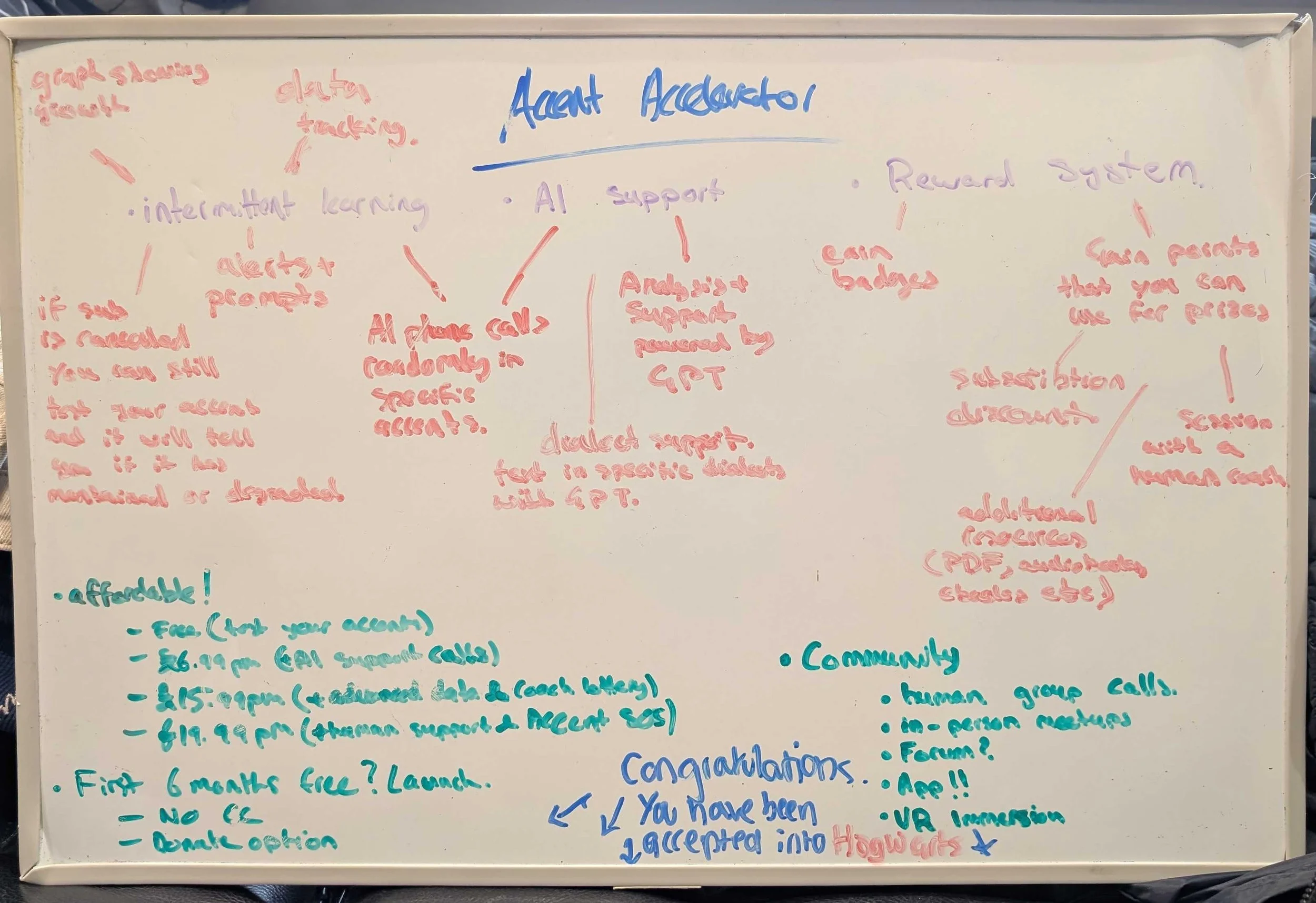
Elijah’s original brainstorm for Accentify in mid 2023
But when I started thinking about what this could be, it was the first thing I turned to.
I outlined a very early strategy for "Accent Accelerator", the first name I had given Accentify. One of the core features at the time was creating a marketplace where people could connect with native speakers in an "Ask The Community" type setting and getting accent recordings on-demand. A version of the Facebook group but with proper infrastructure.
As it came closer to the time of preparing to start my journey in Founder Institute, I had rounded the idea into an app, blue-printed on Duolingo's bite-size learning concept, but for accents.
We later scrapped the Ask The Community idea, for the same reasons why the Facebook group didn't work - it wasn't practical, scalable and it didn't reduce the anxiety that came with learning from random people. Our stripped back, pre-MVP were bite-sized listen and repeat lessons in-app for GenAm and RP.
Who were the first people you brought in to help turn those GenAm and RP lessons into a working app, and how did you find them?
Elijah:
My co-founder, Beau Thomas. He's an incredible accent coach with a wealth of experience teaching A List actors, creating drama school curriculum and building accent courses.
He contacted me through Reddit when I was doing early surveys for my idea, and now, as Chief Learning Officer, leads production for accent courses and user submissions in Accentify.
What do you remember about your first conversation with Beau? What made you feel he was someone you wanted to build Accentify with?
Elijah:
He messaged me saying he really liked the idea and wanted to chat to me more about it. We had a few early conversations on Reddit, then on Zoom, then met in person in an extremely packed pub in London.
I had been searching for a co-founder for a while. First in FI, then in YC and then over LinkedIn but no-one quite matched. Beau was perfect. He was a young artist, hungry to change the industry and was deeply bought in to the mission. With me being an actor and him an accent coach, we were perfectly poised as the customer-problem and the customer-solution, so I couldn't have asked for someone better.
It was perfect and 3 years later we're stronger than ever!
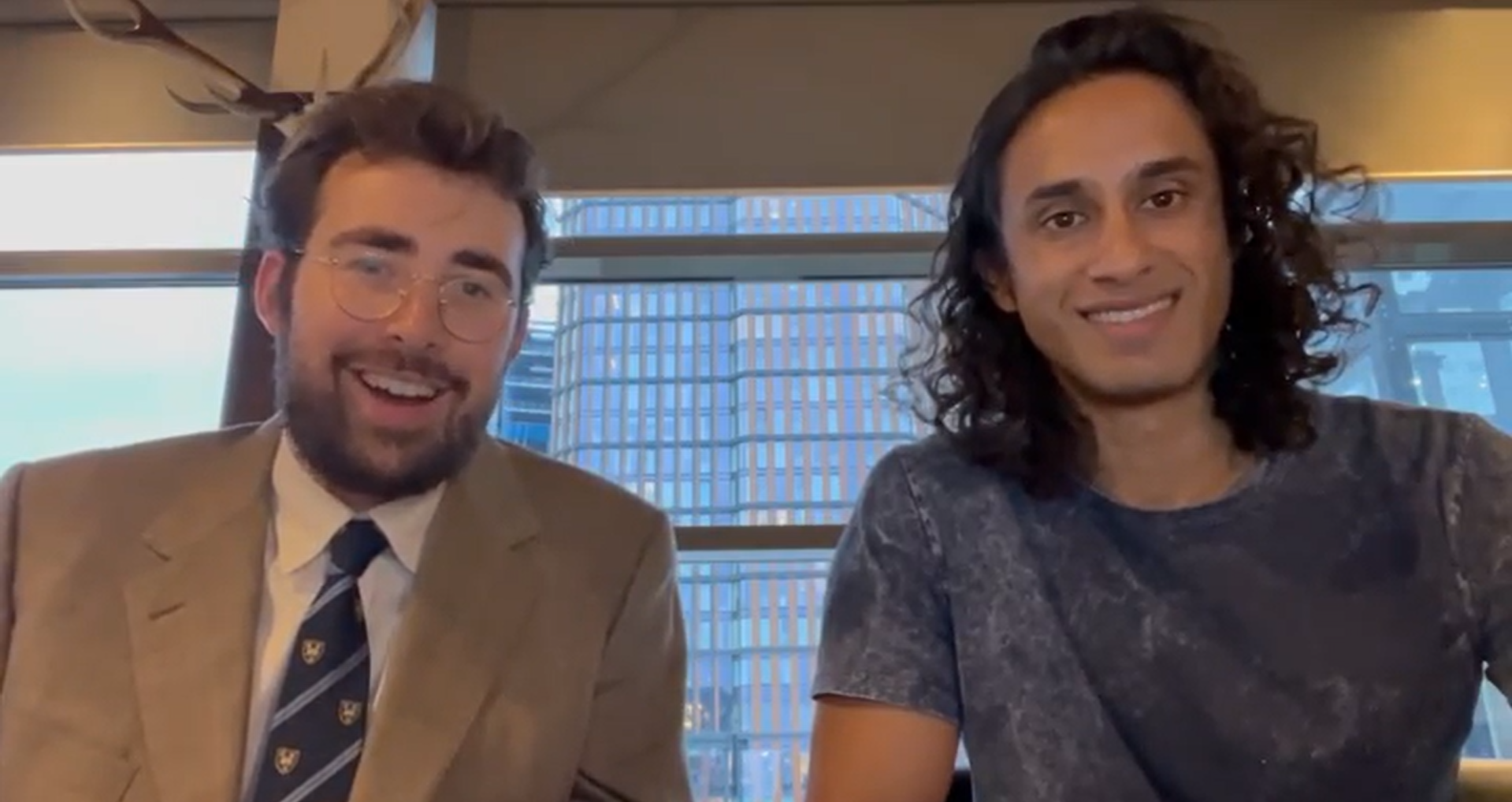
Elijah Khan and Beau Thomas during their 2026 application for Y Combinator
What happened when you first put an early version of Accentify in front of people outside the team? Is there a particular piece of feedback or a user's reaction that you still remember?
Elijah:
I brought together 5 people for in-person alpha tests and the first time we revealed the app and after we actually got it to work the first few things I discovered was how much this had impacted everyone's acting careers. The feature people wanted the most was the ability to go back and re-do lessons after completion. Although it seems obvious, this wasn't in the initial MVP so when the lesson was complete, you could no longer access it. Now, we users can re-take lessons as many times as they want and we keep adding new content into courses too.
What were those five testers telling you about how accents had affected their acting careers? Was there one experience someone shared that stayed with you?
Elijah:
The experience amongst actors are similar. We all want to break into new casting brackets for roles we'd be perfect for but just can't get the accent down. For other actors, and this was true for some in our Alpha Test group, their native accent had shifted with time as they had travelled from place to place, so they struggled with speaking like the place they were from. The problem was the same though - they needed to learn an accent to grow their careers in Film, TV and Theatre.
When did you realise Accentify could be useful beyond acting? What were people outside the industry hoping it would help them do?
Elijah:
I always knew Accentify was useful beyond acting as, although it's called 'accent training' on the tin, we're actually helping improve people's speech. Even today, in 2026, there is a massive bias towards the General American and British Received Pronunciation accents and stigma against all the others. People judge others within seconds based on how they speak due to archaic social norms.
One of my aims is to end accent bias. 90% of people report being judged on how they speak and 80% felt like they had to change their accent to be taken seriously at work. This is disgusting and completely unacceptable. It also fuels a whole separate industry of 'accent softening' or 'accent reduction'; a trade based on other people feeling like they're not good enough or need to change something fundamental about themselves to be shown respect.
Your accent actually carries stories, memories, culture, history and so many more incredible facets formed over generations. We need to conserve it. Not change it.
By exposing everyone to world's accents within one unified ecosystem, I hope to reduce the unconscious (and often conscious) prejudices that grows within us.
It's a big task, but we'll get there.
Soon, English learners will be able to learn English in the accent they want, no longer bound by the constraints of General American and British RP. If someone is moving from Valencia to Merseyside, they'd probably want to learn English in the Scouse accent rather than RP. Or maybe someone from Poland is moving to Dublin. I'd suspect an Irish accent would suit them better than anything else if they were learning English fresh.
Of course, if they wanted to keep their foreign accents, they can as well!
Whether it's for acting, professional life, a love of languages, travel, content creation or just for fun, people now have the choice to do whatever they want with their voice.
What has been the hardest part of turning that mission into a working app, and what has kept you going when it got difficult?
Elijah:
The hardest part has been trying to keep up with the user demand. It's incredible how much users want more accents, more opportunities for feedback, more features and pushes me and the team to deliver them to as best as possible. One of the biggest features for us is Tify, our AI accent coach. No one has ever created voice technology that can detect, understand and then give nuanced feedback on every single accent in the world. And this is an even harder task given that accents evolve and change on daily basis.
This has also kept me going. The fact that we are creating a first-of-its-kind technology that is going to become a personal speech agent in everyone's pockets is something I wake up for everyday. But more than that still, is knowing that people from all walks of life, be actors in LA, an author in the English country, a drummer in New Zealand, or whoever it may be, wants to learn accents is incredibly encouraging. So even when times are tough, churn is high or we've had a couple months of low revenue, I know people want to learn accents and we can't disappoint them. That's what drives me.
Download Accentify to start learning an accent, or meet Elijah and Beau.