Do you have to lose your accent to speak clearly?
No. You can speak clearly and keep the accent that sounds like home. Some pronunciation changes may help a particular listener follow you, but sounding more British or American is a separate goal.
That distinction matters when someone says, “You need to work on your accent.” What exactly are they struggling with? A word they missed? A sentence that rushed past? Or a voice they simply weren't expecting?
You deserve a more useful answer than “sound less like yourself”.
Three things that often get bundled together
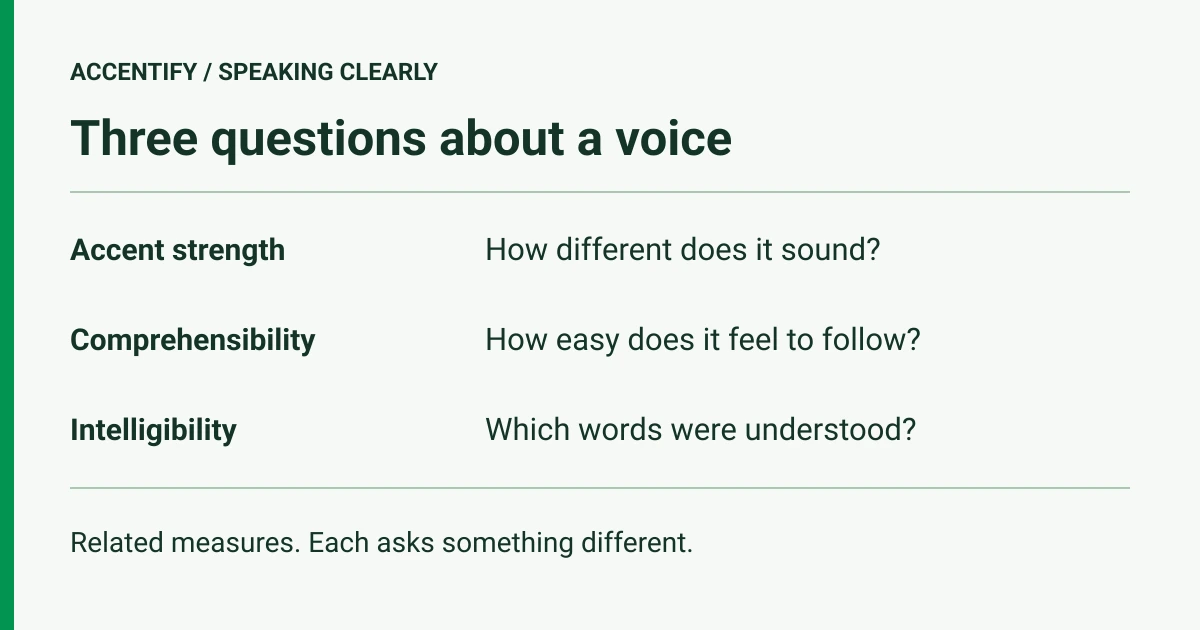
Pronunciation researchers distinguish between accentedness, comprehensibility and intelligibility. In everyday terms, these ask how different a voice sounds from a reference, how easy it feels to follow, and which words a listener actually understands.
In Munro and Derwing's 1995 study, listeners could understand speech that they also judged strongly accented. The measures were related, but a strong accent didn't automatically mean a message was hard to understand.
It helps to keep those questions separate when you ask for feedback. “Which word did you hear?” gives you something to investigate. “Do I sound native?” asks for a comparison with a particular voice or accent.
The American Speech-Language-Hearing Association also describes accent modification as an elective service. An accent, by itself, is not a speech disorder.
Why an AI score needs a closer look
A recent study makes the distinction particularly relevant to anyone practising with automated feedback.
In The Cost of Sounding Different, researchers found accent-related differences in audio models' ratings even when transcription remained strong. They evaluated synthetic speech across several tasks and added human recordings for the interview task. The findings varied by model and setting.
The study tests model behaviour in controlled scenarios. It doesn't establish how every interview platform, language test or accent-training app performs.
If an automated tool gives you a low speaking score, find out what it is scoring. Recognising the words, comparing your pronunciation with a chosen target and judging the quality of a presentation are different jobs. A number without that context gives you very little to practise.
Start with the message you need to get across
Choose a sentence you actually use. It could be an introduction at work, a line from an audition scene or an explanation you've had to repeat.
Record it in your usual voice. Ask a willing listener to write down what they hear, without showing them your script first. Then ask where they needed more effort to follow you.
Try it with a partner first. Ask them to turn away from the screen. Play this short Australian course recording by Beau Thomas once and ask them to write down the words. Then ask which part took the most effort to catch.
Reveal the transcript and compare
Beau Thomas, Australian English: “New shoes”.
If you wrote “new shoes”, both words got through. You can still report that one took more effort. Switch roles and do the same with your own sentence.
Suppose your sentence is, “We need the revised figures by Friday.” If the listener misses the deadline, try giving that part more space or emphasis. If they miss one word, listen to that word in context and work on the specific difficulty.
Change one thing and record it again. Your aim for this exercise is to make that message easier to follow. This is a practical self-check, rather than a formal test of your English or a verdict on your accent.
Keep the setting in mind, too. Background noise, an unfamiliar name or a poor microphone can all make a conversation harder. Ask about those before assuming your whole voice needs an overhaul.
When learning another accent is the point
You might want a different accent for a character, a new creative skill or the sheer pleasure of trying it. That's a perfectly good reason to train.
For a role, choose the voice the character needs. “Clear” alone won't tell you whether to practise Received Pronunciation, Standard Scottish English or something more specific. Our reference-voice guide helps you narrow the target.
You can also work on communication while keeping the features you value in your own speech. If you'd like a record of that voice, our regional-accent recording guide is a useful place to start.
Make feedback earn its place
Useful feedback identifies a moment, explains the task and gives you a manageable next attempt. Ask for that level of detail, whether the feedback comes from a person or a tool.
Being treated unfairly because of an accent is a problem with the judgement being made. It doesn't tell you which sound to practise. A specific communication difficulty deserves a specific response; your choice of voice stays yours.
Take one listener’s answer into your next recording. If they heard the words you meant, ask whether there is anything you actually want to change.