
Accent training for actors: how to choose a reference voice
An accent reference is a recording of someone whose voice you study when preparing a role. Start with the character: where they grew up, when the story takes place and what the script or director asks for. Look for a real speaker whose background fits those details, with clear audio and enough natural speech to study.
If the brief only says “British” or “American”, write down what you still need to clarify. For a particular production, a director or dialect coach may have a more specific target in mind.
Start with the character brief
Make a short research note before you search for recordings:
Location: the region, town or community relevant to the character.
Period: contemporary speech or a historical setting.
Background: what the script establishes about where the character grew up and lived.
Situation: casual conversation, a formal speech or another setting.
Open questions: details that need confirmation from the production.
For example, “a present-day character who grew up in Glasgow” gives you a more useful starting point than “a Scottish accent”. This is an example role. People from the same city can sound different, so check the speaker’s background too.
Find recordings with context
The International Dialects of English Archive (IDEA) was established to provide actors with real-life accent and dialect models. It lets you find recordings by location and speaker characteristics, with transcriptions and commentary alongside the audio.
IDEA recordings include a reading and unscripted speech. Listen to both: the transcript helps you locate a passage, while the unscripted section gives you another context in which to hear that speaker.
Keep the source page with your notes. A clip labelled “British accent” tells you much less than a recording with a documented speaker background.
Check the recording before committing to it
Use these five checks when comparing possible references:
Place and period: how closely does the documented speaker background fit the brief?
Background: what do you know about where the speaker grew up or lived? What is unknown?
Natural speech: can you hear the person chatting in their own words, as well as reading aloud?
Clear audio: can you follow the speaker without music, overlapping voices or distracting noise?
Source and access: can you return to the original page, recording and notes?
A person's birthplace alone is an incomplete research note. Read the available background rather than filling the gaps with assumptions.
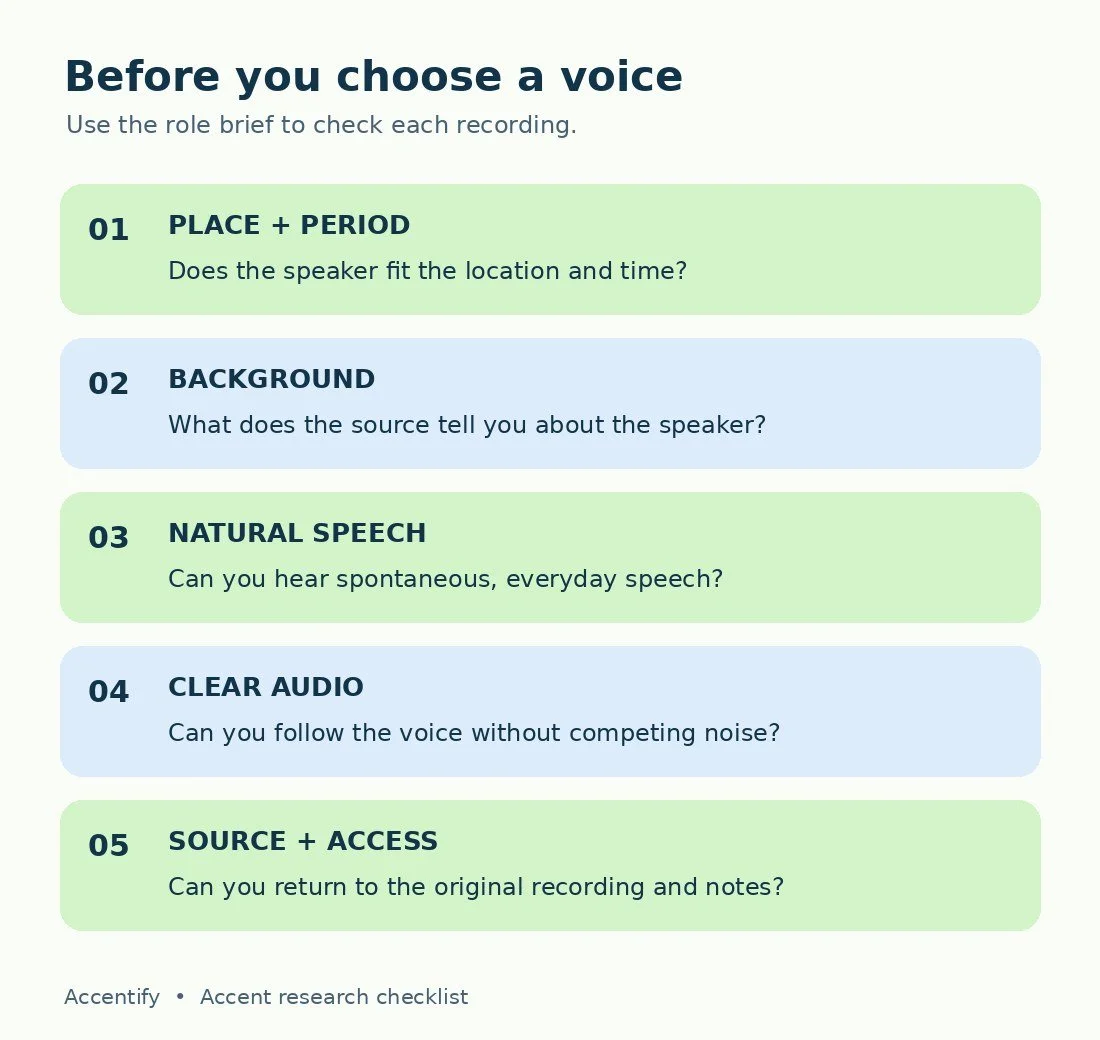
Use these questions alongside the role brief when comparing recordings.
Keep simple rehearsal notes
Copy this outline into your rehearsal notes:
Role and accent brief:
Whose voice you’re studying and the recording link:
Background relevant to the role:
Passage or timestamp to revisit:
Features to discuss with a coach:
Questions still unresolved:
Choose a short passage you can find again and describe what you hear in ordinary words. For example: “I want to check where the speaker pauses in this sentence.” Treat that as a question for further work, rather than assuming your first interpretation is accurate.
You can also compare another documented speaker from the relevant area. Keep the differences in your notes; one recording should not become a claim about everyone from that place.
Use the source without reposting its audio
IDEA is free for personal research, but its recordings remain copyrighted. Its copyright and credit guidance allows linking to sample pages and sets separate conditions for copying or distributing sound files.
Keep a link to the original recording. If you want audio for a public reel, blog or other published project, check the source's reuse terms before including it.
Add structured practice
A reference recording gives you material to investigate. Guided lessons and feedback can help you work through questions that arise during rehearsal. If your target is General American, explore Accentify's General American course.
Before a role-specific audition or performance, confirm the intended accent with the production and seek qualified feedback on your work. Keep these notes alongside your script so you can find the recording again as you work on the character.